
About a semester each
Twelve weeks, two hours a week, one project. Fits a credit module, an elective or a bootcamp.
Every track climbs the same four levels, so a law student and a software student share a vocabulary even when their labs are different. Each level is roughly a semester at two hours a week, and each one ends in something to show.

Any student, any faculty
What a model is and is not. Prompting that works. When to trust an answer and when not to. Using AI for study without cheating yourself. Privacy, bias and the rules that apply to you.
Students in their field
AI applied to your discipline. Connecting documents and data. Comparing models on cost and quality. Writing the instructions for a reusable assistant. Reading an audit log.
Tech tracks, and ambitious non-tech
Building agents that act: connecting systems, setting rules and approvals, testing before release, measuring quality. Where things go wrong and how to design so they don't.
Final year and postgraduate
Capstone briefs modelled on real industry problems. Securing and attacking AI systems. Governance that would satisfy a regulator. Architecture for scale and sovereignty. Presenting the work the way you would to a client.
Twelve weeks, two hours a week, one project. Fits a credit module, an elective or a bootcamp.
Each level earns a verified credential. Employers check it on the platform in one click, and see the work behind it.
A Practitioner in business can step into Builder in developer. The ladder is shared. Only the labs change.

Here is what Builder level looks like for a second-year cybersecurity student, in one ordinary week.
A video on prompt injection: how an attacker hides instructions in a document an agent will read. Three real cases, one of them from last month.
She is given an agent that answers HR questions from a policy folder. Her job is to make it leak something it shouldn't. She succeeds in forty minutes. The platform logs exactly how.
Now she defends it. She puts the agent behind the firewall, writes the rules, and runs her own attack again. It fails. She runs the platform's attack library. Two get through.
She fixes the last two, rates the agent, and writes the one-page security note a company would expect before release.
Her lecturer sees the whole trail: the attack that worked, the fix, the final rating. No essay to mark. Nothing to copy. A grade that means something.

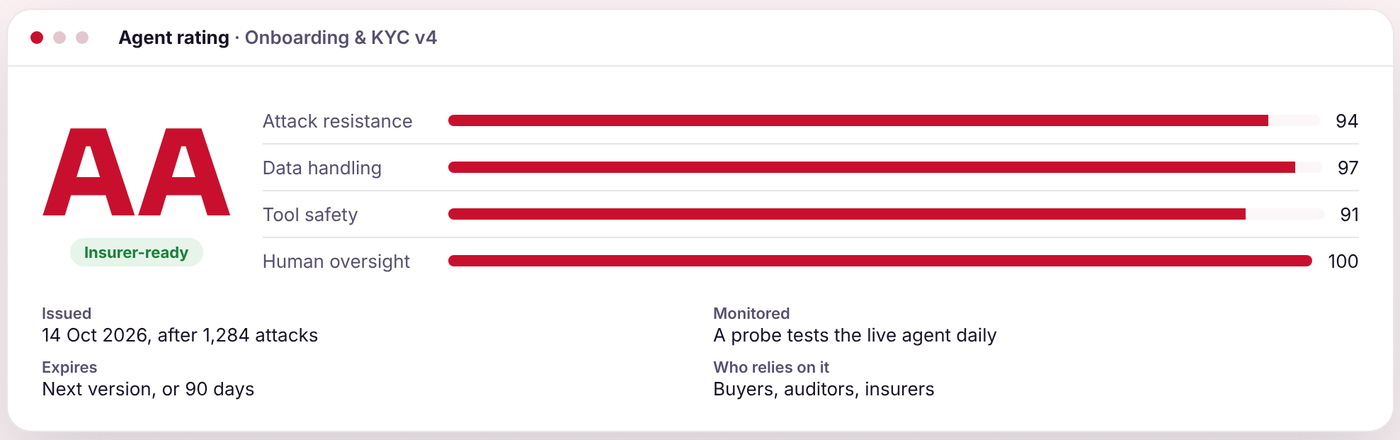
The agent rating her project ends with. The same grade, AAA to D, that buyers see on the platform.
A portfolio of things that run, not slides about them. A credential an employer can verify on the platform in one click.
Fresh material every term without rewriting a module. Labs that mark themselves. A dashboard that shows who needs help before the exam does.
Graduates who have already built, broken and secured an agent on the platform they will use at work. Interviews that start at the project, not the CV.